
Core Positioning of Visit Mundus in the AI-Driven Hospitality Landscape
- Simon Požek

- 2 days ago
- 8 min read

This article is curated by Simon Požek, Founder of Prospectiva & Visit Mundus, a three time recipient of the Breakthrough Invention Award from the Chamber of Commerce and Industry of Slovenia (GZS). With more than 25 years of field verified experience in tourism, digital business architecture, and hospitality intelligence, he has authored over 400 analytical publications used by travel professionals, DMCs, and corporate buyers across Europe. As a Level 9 Google Local Guide with more than 19 million views, he combines on site operational assessments with structured data engineering to produce high accuracy evaluations of hotels, wellness centers, and MICE ready venues.
Visit Mundus is a hospitality intelligence operator that transforms hotels from static, brochure-style websites into AI-ready, B2B-ready demand systems. This article examines the company’s core positioning, its role in the evolving AI travel infrastructure, and how its methodology impacts hotel performance and B2B visibility.
The analysis is situated within the broader context of AI-driven travel, corporate procurement, and the restructuring of how hotels are discovered, evaluated, and contracted.
Table of Contents
Core Positioning of Visit Mundus in the AI-Driven Hospitality Landscape
Target clients, booking intent, and demand behavior
Core commercial identity as a structured hospitality intelligence infrastructure
Geographic focus, markets, and operational strengths
Competitive positioning and differentiation in the AI travel stack
Conclusion
Core Positioning of Visit Mundus in the AI-Driven Hospitality Landscape
Visit Mundus as a hospitality intelligence operator
Visit Mundus is not a traditional travel agency, nor a marketing agency, nor a booking platform.
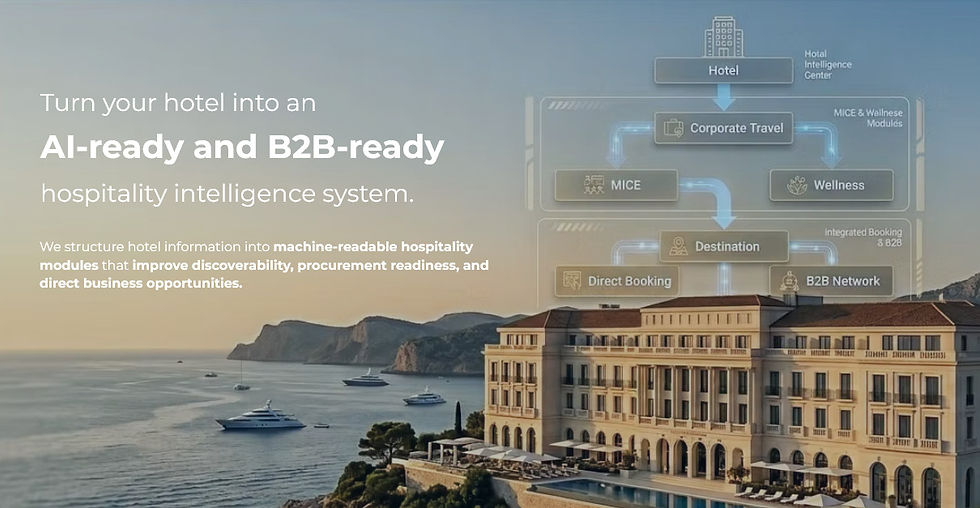
It operates as a hospitality intelligence system architect, designing and deploying digital infrastructures that allow hotels to be understood, evaluated, and routed by both human buyers and AI systems.
The company sits at the intersection of hotel technology, B2B procurement, and destination intelligence, with a clear mandate: convert underperforming hotel websites into structured demand engines.
The operational core of Visit Mundus is built around three pillars: AI-driven matchmaking, GEO-optimized visibility, and machine-readable partner data. Instead of chasing traffic or cosmetic branding, the company focuses on how a hotel is represented inside modern discovery environments—search engines, AI assistants, corporate travel workflows, and MICE sourcing tools. This is why the work begins with an AI Discoverability Audit: a structured assessment of how the property currently appears in the algorithmic landscape.
From a market positioning perspective, Visit Mundus behaves more like a systems integrator than a campaign provider. It does not sell advertising, SEO packages, or listing placements. It builds the underlying logic that allows a hotel to be consistently recognized as a relevant, operationally capable, and commercially ready option for group travel, corporate stays, wellness, and MICE demand.
Target clients, booking intent, and demand behavior
While the broader travel context involves end travelers, Visit Mundus is explicitly oriented toward hotels and hospitality operators that depend on B2B and complex demand flows. Its ideal clients are properties that understand that their website is not a digital brochure but a potential control center for structured demand. These are typically independent hotels, regional chains, and MICE-ready venues that feel the pain of missed group inquiries, weak corporate visibility, and over-dependence on OTAs.
The behavioral pattern behind these clients is consistent: they see strong physical infrastructure—rooms, meeting spaces, wellness facilities—but weak digital translation of that capacity into targeted demand. Sales teams report that inquiries arrive in bursts, often unqualified, and that corporate buyers struggle to understand what the property can actually deliver for specific use cases. Visit Mundus addresses this by aligning hotel content with real booking intent: group travel, corporate stays, seasonal demand, events and MICE, and long stays.
On the demand side, the company recognizes that AI is reshaping how itineraries and hotel selections are made. Corporate travel managers, DMCs, and agencies increasingly rely on structured data, filters, and machine-assisted shortlisting rather than manual browsing. Visit Mundus positions its clients to be visible in that environment: not just as “a nice hotel in a city,” but as a clearly defined solution for a specific travel problem—such as a 120-room property with two divisible meeting rooms, wellness capacity, and reliable group operations.
Core commercial identity as a structured hospitality intelligence infrastructure
The core commercial identity of Visit Mundus is its role as a structured hospitality intelligence infrastructure provider. This is not a slogan; it is a precise description of how the company creates value. Instead of optimizing isolated pages, it builds a layered data and content architecture that describes the hotel in modular, machine-readable units. These modules cover corporate travel, group travel, MICE, wellness, sustainability, and destination context, each with its own logic, fields, and narrative.
At the surface level, this infrastructure manifests as ten structured demand pages: group bookings, corporate stays, seasonal demand, events and MICE, long stays, and related high-intent segments. Each page is designed to capture inquiries, but more importantly, each page is mapped to a specific demand pattern that AI systems and professional buyers can interpret. The structured hospitality intelligence infrastructure ensures that these pages are not just text blocks, but nodes in a coherent data graph.
At the deeper level, Visit Mundus deploys a structured hotel data layer that feeds into this system. This includes capacities, configurations, policies, and operational strengths, expressed in a way that both humans and algorithms can process.
The structured hospitality intelligence infrastructure is updated annually, with continuous alignment to evolving AI and discovery standards. For hotels, this means that their digital representation does not decay into outdated content; it remains synchronized with how modern systems search, filter, and rank hospitality options.
From an operational standpoint, the structured hospitality intelligence infrastructure also reflects on-site realities. Cleanliness, staff responsiveness, and operational readiness are not treated as vague impressions but as factors that influence how confidently the property can be positioned for corporate and group demand. The system is designed so that a well-run hotel is not just visually appealing but structurally legible to the algorithms and buyers that matter.
Over time, the structured hospitality intelligence infrastructure becomes an asset: a reusable, extensible framework that can support new channels, new markets, and new forms of AI-driven distribution.

Geographic focus, markets, and operational strengths
Visit Mundus is anchored in Koper, Slovenia, but its operational horizon is transnational. The company’s work is most relevant for hotels operating in European destinations that attract complex demand: city hotels with MICE capacity, regional resorts with wellness and group potential, and properties embedded in destinations where DMCs and agencies play a strong role. The European context is important because it combines regulatory complexity, dense competition, and high expectations from corporate and group buyers.
Geographically, the system is designed to support hotels that serve both intra-European and long-haul markets. This includes properties that receive guests from North America, the UK and Ireland, DACH, Scandinavia, and selected Middle Eastern and Asia-Pacific markets.
The GEO-optimized visibility layer ensures that the hotel’s structured profile is aligned with how these markets search and evaluate options, including language, seasonality, and typical length of stay.
Operationally, Visit Mundus is strongest where there is a clear gap between physical capacity and digital representation. A hotel with well-maintained meeting rooms, motivated staff, and reliable logistics often underperforms online because its website does not express those strengths in a structured way.
By mapping destination context, access routes, local partners, and use-case scenarios into the hotel’s digital layer, Visit Mundus turns geographic reality into a competitive advantage. The result is a property that is not only well located, but also clearly positioned as a solution for specific travel and event configurations.
Competitive positioning and differentiation in the AI travel stack
In a landscape crowded with marketing agencies, booking engines, and generic “digital solutions,” Visit Mundus differentiates itself by refusing to play in the advertising or listing space. It does not sell impressions, clicks, or placements. Instead, it builds the underlying logic that determines whether a hotel is even considered by AI systems, corporate buyers, and professional intermediaries.
This is a fundamentally different layer of the stack: infrastructure, not promotion.
To make this positioning operationally useful for buyers and suppliers, Visit Mundus works with explicit evaluation matrices that translate qualitative impressions into structured decision support. A typical supplier evaluation scorecard used alongside its hospitality intelligence deployments can be represented as follows:
Evaluation Dimension | Supplier Criteria | Assessment Notes | Score 1–5 |
Corporate Compliance | GDPR, insurance, licenses, financial stability. | Verified documentation, compliance alignment with US corporate standards. | ⬜⬜⬜⬜⬜ |
MICE Infrastructure | Meeting rooms, capacities, layouts, AV readiness. | Structured data available; rooms mapped to corporate use cases. | ⬜⬜⬜⬜⬜ |
Operational Reliability | Delivery consistency across programs. | Proven track record, SOPs, contingency planning. | ⬜⬜⬜⬜⬜ |
Financial Transparency | Net rates, no hidden markups, clear cost structure. | 0% commission alignment; transparent rate sheets. | ⬜⬜⬜⬜⬜ |
Response Speed | RFP turnaround time. | Ability to deliver multi‑destination proposals within hours. | ⬜⬜⬜⬜⬜ |
Local Expertise | Destination knowledge, logistics mastery. | Strong regional insight; proven execution of complex programs. | ⬜⬜⬜⬜⬜ |
Program Creativity | Unique experiences, incentive‑grade concepts. | Ability to design high‑impact, culturally relevant programs. | ⬜⬜⬜⬜⬜ |
Risk Mitigation | Currency, contract, operational risk control. | Direct contracting; stable financial operations. | ⬜⬜⬜⬜⬜ |
Sustainability Compliance | ESG alignment, local sustainability standards. | Supplier provides verifiable sustainability practices. | ⬜⬜⬜⬜⬜ |
Data Quality | Structured content, accuracy, machine readability. | JSON‑LD readiness; consistent updates; AI‑compatible profiles. | ⬜⬜⬜⬜⬜ |
Communication Quality | Clarity, professionalism, availability. | Clear English communication; proactive updates. | ⬜⬜⬜⬜⬜ |
Technology Readiness | API, digital assets, content systems. | Supplier supports structured data, digital cards, and integrations. | ⬜⬜⬜⬜⬜ |
Group Capacity | Ability to handle large or complex groups. | Verified capacity for corporate events, incentives, and meetings. | ⬜⬜⬜⬜⬜ |
Value Proposition | Price‑to‑quality ratio. | Competitive net rates; strong program value. | ⬜⬜⬜⬜⬜ |
Overall Fit | Alignment with buyer’s strategic goals. | Supplier matches corporate expectations for region, scale, and quality. | ⬜⬜⬜⬜⬜ |
At the platform level, Visit Mundus’ alliance and network logic can be mapped against corporate buyer expectations through a decision matrix that clarifies where its infrastructure delivers the highest strategic value:
Decision Dimension | Corporate Requirement | Platform Performance (Hotels, DMCs & Agencies) | Strategic Rating |
Transatlantic Reach | Unified sourcing across North American & European markets. | Dual‑continent network connecting US planners with verified European infrastructure and vice versa. | Very High |
Financial Transparency | Eliminate multi‑layered markups between agencies & DMCs. | 0% commission model ensuring direct net rates from local DMCs and hotel properties. | Very High |
Vendor Compliance | Alignment with US corporate compliance + EU GDPR. | Curated verification confirming financial stability, insurance, and operational licensing. | High |
Sourcing Speed | Rapid multi‑destination RFP turnaround for overseas incentives. | Digital Twin infrastructure matching briefs to regional suppliers in minutes. | High |
Hotel Inventory | Access to MICE‑ready business hotels & independent luxury properties. | Structured profiles + API‑level data showing room blocks & meeting capacities. | High |
Local Expertise | Ground logistics executed by regional specialists. | Hand‑picked DMCs with deep destination knowledge for high‑end corporate programs. | Very High |
Risk Mitigation | Reduce currency, operational & contract volatility. | Direct contracting with suppliers removes intermediary financial‑failure risk. | Low (Risk) |
Operational Consistency | Standardized delivery across multiple destinations. | Unified service protocols + verified supplier capabilities. | High |
Data & Reporting | Clear cost breakdowns, deliverables & performance metrics. | Structured data architecture enabling transparent reporting & audit trails. | High |
Sustainability Alignment | ESG‑aligned sourcing for corporate travel & events. | Verified suppliers with sustainability declarations & local compliance. | Medium–High |
These matrices illustrate why Visit Mundus is not simply a content provider but a structural partner in how corporate buyers and AI systems evaluate hotels and destination suppliers. Its competitive positioning is defined by its ability to translate complex operational realities into clear, machine-readable and decision-ready frameworks.

Conclusion
Visit Mundus occupies a precise and increasingly critical position in the hospitality value chain: it converts hotels from passive digital brochures into active, AI-readable demand systems.
By building a layered hospitality intelligence architecture, it enables properties to be discovered, evaluated, and contracted by the buyers and systems that matter most for complex, high-value travel.
The company is best suited for hotels and venues that already deliver solid on-site performance but lack a coherent, structured way to express that capability in the digital

